All posts by Ian Angell

Economic Suicide by Excessive Regulation

When will the British Governments ever learn. The unpalatable truth is the present policy of taxation is skewed to take off the top quarter of the population. This group is sick and tired, not only of the amount they are paying in tax, but the increasing intrusion on their privacy. The latest demands to spy on bank accounts, and even take money to settle unpaid demands in advance, is the latest of a series of sinister events.

Most of this group are stuck, however, the top end, what I label the Golden Geese are not. We are reaching a tipping point where they will fly away. The ‘name and shame’ policy around the clients of Ingenious Media is causing a furore.

If they are no longer tax domiciled in the UK, then they don’t owe any tax, and so will escape the net. Most of these people are ‘citizens of the world’ anyway. The spend their lives travelling the globe. The more they are attacked by the state, the sooner they will cut their tax-ties to it. … The Flight of the Golden Geese. And the state … it will have to increase taxes to make up for the shortfall. Suicide by jumping off the fiscal cliff.

The cost of dying index

Forget about the `cost of living`, the `cost of dying` has increased substantially for many in the UK. Because of large increase in the cost of real estate over recent years, the proportion of properties in Britain that have now fallen into the net of `death duties` (inheritance tax) has gone up from 13.5% to 20% in just five years. And remember when the final tax bill is calculated, the value of the goods, chattels, bank accounts and investments left in the deceased’s estate are added to the taxable total.

This increase is because the threshold of this 40% tax, £325,000, hasn’t changed since 2009. What  a devious way to to raise the tax take. Last years receipts of £3.4 billion have gone up 20% over the intervening five years. London and the South East are hardest hit of course: 47% of London houses and 27% of SE houses are now over the threshold. In Kensington and Chelsea 96% of properties are hit.

Canada, with no estate taxes, is looking increasingly attractive to elderly British high net worth individuals, who because of death duties, are contemplating becoming Golden Geese.

White Collar Crime

10387553_10154344041260271_4865283359936858288_n
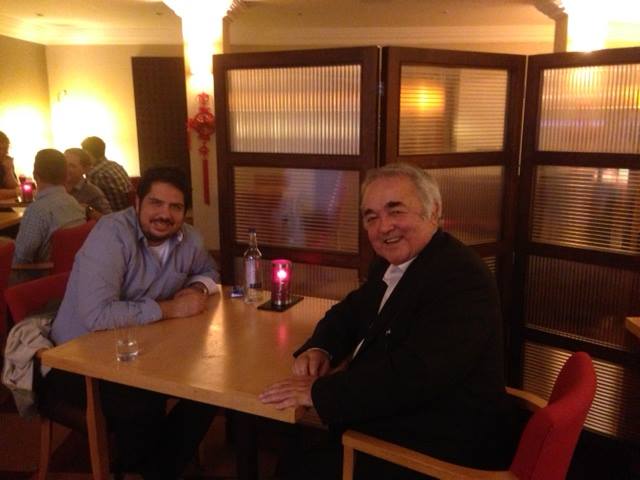
10pm, 2 July 2014. Here are Dionysis and I after enjoying an excellent meal at the Sampans Restaurant at the Filton Holiday Inn near Bristol. They have a real star with the chef.

We were attending a White Collar Crime Conference at the University of the West of England Campus that was next to the hotel. Fascinating talks by some excellent speakers.

Socks, Sandals and the Politics of Envy

The socks and sandals Liberals are at it again. After a disastrous showing in the European Elections, their leader Clegg thinks the way to recover lost ground is to push the politics of envy down the electorate’s throat. Bash the wealthy, and promise to dole out money to everyone else. That will reignite his party’s populist credentials. They are flogging the dead horse of the Mansion Tax again.

I don’t want to go into the arguments again – see my blog of April 14, 2014. Suffice it to say, the tax raises far less than expected, while building resentment among the wealthy who will spend their money elsewhere.

Dominica: destination of choice

Dominica: the destination of choice for many Golden Geese. So says a recent BBC online news article.

Surely not? A quick check of the CIA Factbook will show it is an island 751 square kilometers in area, with a population of 73,449. I ask myself, ‘but would I want to live there?’

But then I imagined my co-author David’s response ringing in my ears. ‘Because of all the islands in the Caribbean, its price for selling a passport is still the lowest. You can buy citizenship there for around $100,000 dollars, after being interviewed by a government committee. And who mentioned anything about living there?’

‘Remember it’s only a passport … merely a travel document. Dominica is a member of the Commonwealth, and so passport holders have special privileges in the UK. They can also travel to around 50 countries without a visa. It’s estimated that some 3000 Golden Geese have already made the flight there.’

Enough said.

“I am not a number.” Fighting the government over ID cards.

“I am not a number. I am a free man!” The words of Patrick McGoohan as Number 6 in the TV series ‘The Prisoner’ come to mind.

It’s hard to believe that it’s been nearly nine years since a team of Information Systems academics at LSE (Gus Hosein, Simon Davies, Edgar Whitley, myself and others) published our report, The Identity Project. The date was June 27th 2005. We were trying to inform public debate on the UK government’s ID card proposals. Among the many findings, we gave our cost estimates: between £10 billion and £19 billion over ten years. The government figure was just over £5 billion.

To be honest I personally expected the figure to be much higher, but we stuck on these numbers because they are easily justified using figures obtained from the Home Office itself – not that they are the most reliable of departments, as we all have recently discovered. In 2010 we learned that ten ‘illegals’ had been working at Becket House, the south London headquarters of the UK Border Agency, which vets immigrants! A further two found work at the Home Office’s Whitehall HQ, one as a security guard! They never learn. In 2014 Mark Harper, the immigration minister behind the controversial “go home” adverts urging illegal immigrants to leave, resigned because his private cleaner for seven years did not have permission to work here.

Anyway, we used Home Office numbers, because we weren’t looking for trouble. But trouble we got. The present British government believes in shooting the messenger with bad news.

Ministers went on the offensive – offensive being the operative word. No less that the then Home Secretary, Charles Clarke, went on the BBC to accuse us of spinning, and leaking material to the press for maximum exposure (like they do.) Tony Blair, the then Prime Minister, attacked us in the House of Commons. Second rate ministers lined up to pour scorn on our Report. Classic Socialism 101: “if you can’t rubbish the message, rubbish the messenger.”

Our figures were “simply mad,” and we were “technologically inept.” Simon Davies, a lead researcher, was singled out, and ‘smeared’ on the Today Programme on Radio 4, and all over the media. The reason? The press had fallen on our figures, to say that ID cards would cost £300 per person; not £93 as the government insisted. And guess what rigorous research gave them £93? A little biddy phoned to tell me they got it from a focus group – apparently, £93 is the amount that the market would take. When you stand up to bully-boy politicians you’d be amazed how many little birdies get in touch to dish the dirt.

But nowhere did we actually claim that each person would be charged £300 for their ID card – that was the press. We only gave the total price. There is no way of calculating total costs, because it is impossible to comprehend the consequences: we may know the price of ID cards, of any technology, however, the costs will accrue from here to eternity.

Indeed, I would be the first to admit that the project could end up in profit. If the world’s many other totalitarian regimes are convinced that ID cards are a great idea, then the income from sales could far exceed expenditure. I bet the government is now sorry that they toppled Saddam Hussein and Colonel Gadaffi – they would have been first in the sales queue. Still … they could always count on others among the world’s dictators to become customers.

Anyway, it was all good knockabout stuff. Prior to the first Commons Vote (June 29th, 2005), the then LSE Director, Sir Howard Davies, was telephoned by a senior Civil Servant and asked to pressurize us into withholding our report until after the vote. But Sir Howard, an ex-civil servant himself, had gone native. He came up trumps, publicly rebuking both Prime Minister and Home Secretary in a letter to the Times. The issue was raised at an LSE Governors meeting, where Bob Worcester of MORI waded in. He said his findings showed that whenever the government says one thing, then 83% of the population believes the exact opposite.

We were given the governors’ total backing. They had actually read our report, which our critics obviously hadn’t. If I say so myself, it is an excellent piece of academic work … unlike the Home Office’s response, which was appallingly written, and full of factual errors. I likened it to “a student summer project from a 3rd rate university.” Don’t take my word for it – you can see for yourself: the LSE report, the Home office response, and our response to their response are all on the LSE web site.

Thankfully I worked for a university that wouldn’t be intimidated by bully-boys – how many other British universities can say the same? Be quite clear, intellectual freedom is under attack in today’s Britain, and by the very same people who insist that “the innocent have nothing to fear from ID cards.”

Anyway the government needn’t have worried; after a very rough ride, the bill was finally passed by the voting fodder in the Commons on 13th February 2006, albeit with some nominal concessions, and received Royal Assent in March.

However, the project has fiasco written all over it. I say this not as a privacy advocate, because I’m not one, but as a student of Information Systems; one who subscribes to the cockup theory of history, not conspiracy. This ID card system will be one almighty cockup.

The ID card project, as proposed, was going to be one of the biggest computer systems ever envisaged – far more complex than the NHS system. It’s a disaster waiting to happen. £5.8 billion – don’t make me laugh!

Nevertheless I see silver linings among the dark clouds of ID cards. There’s huge money to be made from this vast gravy train. During the recent Commons vote I was praying for a government win. That may surprise you. I’m a professor of information systems: of course I want to study the Titanic from the drawing board to the iceberg. Of course I want to observe what will be the biggest in a whole line of public sector disasters. {Have there been any successes?}

Thankfully, after the 2010 General Election, the new coalition government saw sense and dumped the project. Not that they don’t want to spy on British subjects, rather they were frightened by the escalating costs.

I say, I say, I say. Why wouldn’t politicians have had photos on their ID cards? Because no one could decide which of their two faces to use. Strong words you might think; but NOT when your team has been slandered by brain-dead ministers simply for publishing the results of your research.

Golden Visas for Golden Geese

Under the Portuguese Residence Programme, Foreign investors who spend 500,000 euros on property in the country have the right to live there. ‘Golden Visas’ are also available to those who invest a million euros in capital, or create 10 jobs in Portugal.

For this successful applicants have unfettered travel around the Schengen area, and after six years they can apply for Portuguese citizenship. Starting in 2012, 734 of these Golden Visas have been issuedto date , raising inward investment of nearly half a billion euros. Nearly six hundred of these have come from China.

Spain has a similar scheme, but they are being undercut by Cyprus with its price tag of 300,000 euros. Greece comes in even lower at 250,000 euros.

Is this the shape of things to come?

Thanks again to BBC News online for the information.

Jim Feist

jf_wed
While I was in Las Vegas at a Computer Security Conference recently, I had the great pleasure of meeting up with Jim Feist. He treated me to lunch at Kojo’s at the Orleans. I had been introduced to him by my co-author David Lesperance.

Jim is an American Institution. He is a famous ‘capper, or handicapper … what on this side of the pond we call a tipster … but on a grand scale. He studies the ‘form’ of various sports, and then packages and sells his tips … very successfully. He is the principal panelist on Proline, America’s premier handicapping television show on the USA Cable Network.

Now just in his seventies, Jim started hustling pool at the age of fourteen. Meeting him was like coming face to face with a Damon Runyon character, relocated from New York to Vegas. Rumour has it that he was the model for the Al Pacino character, Walter Abrams, in the 2005 film Two for the Money, co-starring Mathew McConaughey.

Personally I don’t see it. Jim was charming, great to talk to, full of fascinating anecdotes, not a hint of cynicism, and he shared his encyclopaedic knowledge of Vegas freely … nothing like the manic Walter.

Tax Arbitrage

Last evening I was talking on Skype to my good friend David Lesperance, the co-author of our up-coming book, Flight of the Golden Geese. Out of the blue he announced that a significant part of his tax business was helping Canadians transfer to the UK, while at the same time he was facilitating the move of Brits to Canada. At first this sounded crazy to me. Surely one country had to be more tax friendly than the other, and the tax-flight traffic would be all one way. Not so. He explained the phenomenon in terms of differences in tax arbitrage between the two countries.

The Brits were wealthy, and shall we say of a more advanced age. They were seeking permanent tax domicile in Canada, a country that has no Estate Tax – that’s Death Duties in the UK. As Canadian domiciles, when they died their assets and property would be handed over lock, stock and barrel to the named beneficiaries in their wills. If they had stayed in the UK the state would have taken a huge slice (40% of everything over £325,000).

Meanwhile the Canadians were seeking non-dom status in the UK, which meant they would only pay tax on income earned in the UK, but not on capital brought onshore. David once stayed in England for a while, and with no business here, he paid no income tax. Of course he still had to pay to live here, which brought a decent sum into the economy.

The likes of IMF Boss, Christine Lagarde, and others hint at ‘fair taxation’ being necessary to maintain a stable economy, and that states should not set tax rates detrimental to others. This is code for standardizing global taxation … a non-starter. In such standardization would the UK accept the end to Death Duties? Of course not. It would insist on Canada imposing 40%. As for non-dom status, the US would insist that their system of tax based on citizenship be imposed everywhere. At present only three countries use this system … three bastions of democracy: USA, Eritrea and North Korea. The result of standardization would be each tax moving to the highest rate in the world. Hey ho! It won’t happen. Haven’t these tax people heard of the prisoner’s dilemma?