All posts by Ian Angell

The Pomperipossa Effect

Once upon a time, long, long ago (well actually in 1975) in a land far, far away (Sweden) there lived a kindly fairy godmother named Astrid Lindgren. Astrid brought smiles to the faces of children from all over the world with her stories of Pippi Longstocking and other charming characters. Indeed, her stories were so popular that her books became very successful and sold in vast numbers. Her royalty income just grew and grew. And she lived happily ever after?

Well, not quite! A big bad wolf in the form of the Swedish Social Democrat Government had other ideas. It introduced a new tax regime that meant self-employed individuals had to pay both regular income tax and employer’s fees. In Lindgren’s case this meant a marginal tax rate of 102%. Unbelievable. She had to pay more in tax than she actually earned.

This idiocy has subsequently been dubbed the ‘Pomperipossa Effect’ after a allegorical story ‘Pomperipossa in Monismania’ (in English ‘Pomperipossa in the World of Money’), which she published in Stockholm’s evening tabloid newspaper, Expressen, on 3 March 1976. Even the Swedes, who are normally fairly passive over high levels of tax, were incensed. It was no accident that later that year the Social Democrats were thrown out of government after being in power for 44 years.

So there was a happy ending. Astrid Lindgren did live happily ever after paying a mere 80% of her income – she died in 2002. However, this isn’t a fairy story – more a horror story. The big bad wolves haven’t gone away. They have spread out from Sweden to join governments all around the globe. Don’t be surprised when the nightmare of the Pomperipossa Effect suddenly reappears in your country.

Creative Commons License
This work is licensed under a Creative Commons Attribution 4.0 International License.
Attribution: http://www.ianangell.com

In praise of short-termism

Every year the FOA (Futures and Options Association) runs the City Debate,
hosted by the Lord Mayor of London at the Mansion House.
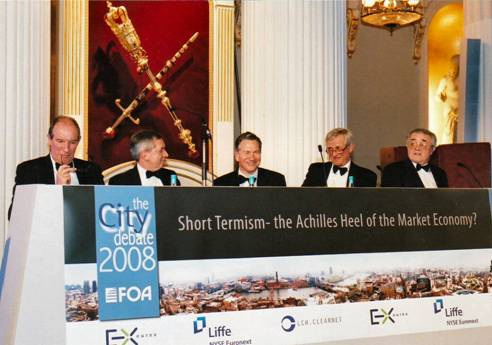
The 2008 event was held on Monday, January 28th, and chaired by Michael Portillo MP.
The Motion was: “Short Termism is bad for Business.”
Speakers for the Motion were:
Will Hutton, Chief Executive, The Work Foundation
Terry Smith, Chief Executive, Tullett Prebon
Speakers against the Motion:
Ian Angell, Professor, The London School of Economics
David Lascelles, Senior Fellow, Centre for Study of Financial Innovation

image002

From left to right: Hutton, Smith, Portillo, Lascelles, Angell

The audience was polled prior to the debate, and the result was 55% for the motion, 33% against, 12% undecided. After a lively debate and some good knock-about interaction with the audience, the final result of the evening was 36% for the motion, 59% against, 5% undecided.

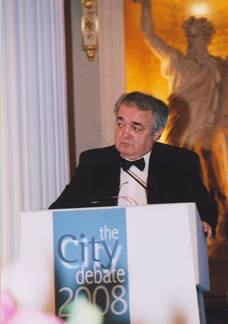
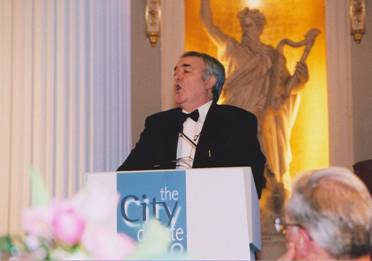
There follows the presentation made by Ian Angell:

“So 55% of you think that short-termism is bad for business. However, that does pose the question of what you mean by ‘short-term,’ and what you mean by ‘business.’ Business is NOT selling something you have, to someone who wants it. Selling something you don’t have, to someone who doesn’t want it. Now that’s business! That means business and acting in the short term are structurally coupled, and it is this coupling that creates the wealth to keep society going.

Most self-appointed curators of society don’t have the skills or the imagination for business, which is why they have always resented ‘trade.’ “Business is nothing but the struggle of wolves over carrion, men of business can hardly be saved for they live by cheating and profiteering.” So said Franciscus Gratianus, a medieval monk. Dante’s Inferno placed usurers alongside sodomites in one of the circles of hell.

image006However, they need you, and so they try to dominate you. They have learned that intimidation is counter-productive, so instead they set out to make you feel guilty, using weasel words like ‘long-term instability’ and ‘unfairness’ to describe business practices. With double talk about ethics and morality, they take cheap shots at short-termism. Theirs isn’t a personal, but rather a public morality: a socially constructed bigotry; a self-referential and self-validating, codified prejudice.

Through rhetoric, their thinly veiled attack on business has been transfigured … into administration … into bureaucracy … into Government. Government, the guardians of public morality! God help us!

And as for democratic Government! You don’t get much more short-termist than that. Talk about the pot calling the kettle black. Their attacks on short-termism in business are just a smokescreen to distract you from the real menace: public morality … which is their excuse for, and a precursor to, interfering: first as regulation, and then taxation. Just look at the UK’s recent ‘simplification’ of capital gains tax: numerous small businesses destroyed in this latest smash and grab raid. Your short-termism isn’t bad for business, but Government short-termism certainly is! As Ronald Regan noted, “the nine most terrifying words in the English language are: I’m from the government and I’m here to help!”

Short-termism is actually the only way that business can instill some discipline into the monopoly of government. That’s the trouble with elections, the government always wins. And using a mere body-count of the manipulated masses, they justify their holier-than-thou intolerance of business.

Don’t allow these pious commentators, these self-promoted representatives of the mob, to enforce the common good. Because the common good isn’t good, it is merely common. Recognize that public morality sees the wealth created by business as belonging to the state. So state leaders feel free to steal it, so they can subsidize preferred voters to stay in power.

As Nietzsche so shrewdly observed: “The victory of the moral ideal is achieved by the same ‘immoral’ means as every other victory: force, lies, slander, injustice.”

The control freaks predict that short-termism, with its excessive focus on immediate earnings, will discourage both long-term creation of value, and investment. What do they know? Nobel-prizewinning Physicist Niels Bohr hit the nail on the head: “Prediction is very difficult, particularly about the future”. Control is a Myth!

If your business is to survive in the long run, it must first survive in the short-term. This requires dealing with the uncertainty by steering in the flow of events. You must cope in the here and now. It’s what humans do; it’s the only game in town. Short-termism is just another word for pragmatism.

image004Business operates in a self-organizing Darwinian ecology. Only the fittest survive. As a great American philosopher once put it: “You got to know when to hold ‘em, know when to fold ‘em, know when to walk away, know when to run.” Kenny Rogers is saying you should be more short-termist. Of course nurture long-term projects, but don’t get locked in. To survive and prosper you must be flexible and adaptive. If necessary, get in and out quickly – keep your assets liquid and transferable.

Operating in the short-term is not an evil; it’s a very precious FREEDOM … the freedom to manoeuvre, not only in the face of uncertainty, but also against the self-righteous oppression of the state, and its self-legitimated violence against the creators of wealth. Be a short-termist!

With the long-term future falling apart, you’d be a damn fool to be anything else. Take advantage! All public morality is a business opportunity for the amoral. Just think how much the City of London has gained from the moral jeopardy that is Sarbanes Oxley. I won’t even mention all the Green sentimentality!

Everywhere sanctimonious authoritarians want to dominate their home turf, but they’re not in charge globally. So arbitrage! If they try to stop you profiting from short-termism over here, then go over there and do the business. Don’t get bogged down in all this government-induced guilt. To hell with the moralizers.

All commerce is about leveraging space (distance) and time. In the age of global telecomms, if you can’t act in an instant, then you’re too late! And since in the long run, we’re all dead anyway, let’s die free men and women. Long live short-termism in business. Long live freedom!”

Creative Commons License
This work is licensed under a Creative Commons Attribution 4.0 International License.
Attribution: http://www.ianangell.com

All taxation is theft

This is a presentation given by Professor Ian Angell at the London Stock Exchange, Tuesday March 7, 2006 in a debate with Sir Nicholas Montague, former head of H.M. Inland Revenue.

“… Thus began the fierce endeavour of the State to squeeze the population to the last drop. Since economic resources fell short of what was needed, … [t]he full rigour of the law was let loose on the population. Soldiers acted as bailiffs, or wandered as secret police through the land. Those who suffered most were, of course, the propertied class. It was relatively easy to lay hands on their property, and in an emergency, they were the class from whom something could be extorted, most frequently and quickly…”

Sounds familiar? No, this isn’t today’s Britain, with its middle classes ravaged by stealth taxes, speed cameras, national insurance, income tax, death duties, VAT, petrol, alcohol, tobacco duty, community charges etc. This is a quotation from The Cambridge Ancient History, on the decline and fall of the Roman Empire. There’s nothing new under the sun. Once again the State is predator. Look closely at today’s Britain, and the same signs are there: such is the end of Empire.

“…If the propertied class buried their money, or sacrificed up to two-thirds of their estates to escape … ; or went so far as to give up their whole property in order to get free of the domains rent, and while the non-propertied class just ran away, the State replied by increasing the pressure…” This is why such large hoards of Roman gold and silver are still being unearthed. The owners were hiding their wealth, not from barbarians, but from the swarms of state registered looters.

Don’t think that this couldn’t happen in a democracy. According to Alexander Tytler, an 18th century philosopher: “a democracy cannot exist as a permanent form of government. It can only exist until a majority of voters discover that they can vote themselves largesse out of the public treasury”  – out of taxation.

In the new globalized socio-economic conditions, governments chosen by the majority are governments chosen by losers. They are losers because labour has become a commodity, and must compete on price. The International Labour Organization calculates that nearly a billion workers have entered the global job market. Why should the world’s sub-employed all live in developing countries? Automation and exportation of jobs is sending shock waves through western workforces previously protected by national interests, but which are now incapable of fending off foreign incursions. Because of the minimum wage, companies are lowering staffing levels. It is no accident that most are instigating downsizing, delayering and outsourcing programmes.

Because of computerised production, the structured world of semi‑skilled labour, that arose out of the industrial revolution, is now disintegrating.  Professor Richard Scase tells us that in the UK today, more people are working in Indian restaurants than in the iron & steel, shipbuilding and coal industries combined.

Meanwhile, the politicians still pretend to be in control. Trust me, “I’m from the government and I’m here to help” (which according to President Reagan are the nine most terrifying words in the English language). Politicians, both the knaves and the naive, pander to the masses. They say they can conjure up hundreds of thousands of new jobs for the huge number of soon-to-be-unemployed. What a nerve! Businesses create jobs, governments create non-jobs and pensions-in-waiting, all paid for by taxes, and in doing so tax real jobs out of existence.

Today, productivity is delivered by a technology needing only a few machine minders. A typical factory employs one man and a dog. The man is there to feed the dog, and the dog insures that the man doesn’t touch anything. Growth is created from talent, not from low-grade labour. It has been decoupled from employment. National economies can no longer grow themselves out of unemployment. A large population, particularly an uneducated and ageing population, is a now liability: a major problem facing all Western governments. The twentieth century, the century of the masses, is over. A degenerate political system based on manipulating those masses is over too, but it won’t go quietly.

Just as in Ancient Rome, they hang on by soaking the rich. Hence, the wealthy look to escape, taking with them as much of their wealth as possible, and a vicious circle of decline begins. A series of tiny tax hikes, each seeming so obvious, harmless, beneficial even, are the first steps on the road to perdition. There are no alarm bells; life goes on, only with each infringement, ethical standards drip away. Drip, drip, drip, until the floodgates open. Then instead of setting standards and punishing wrongdoers, the government is ‘at it’ themselves. Croneyism is rampant; government has become corrupt and corrupting.

Strapped for cash, they will steal (tax) anything in solid form. Taxes will inevitably rise on fuel, food, clothes and property. ‘Who guards the guardians?’ when morality collapses into vice. The ‘will of the people’, voting for full employment, a minimum wage, and fair taxation, is merely the turkeys voting for Christmas. To stay in power, the government needs to subsidise preferred voters, and so it will stuff the turkeys.

Don’t think the other lot will make any difference. That’s the trouble with elections, the government always wins. And if voting made a difference, they would have made it illegal. Whatever the government, they all face the same problem: income collapsing, and expenditure going through the roof. How dare Chancellors call it a budget, when they just steal even more from the public to pay for their mistakes.

To justify their tax take, the state professes a superior morality. However, the legitimacy of the state does not stem from any unassailable moral position, but from raw power: the domination of the individual by the tribe. This is the same immoral morality that deludes ‘incorruptible’ tax collectors and policemen as to the rightness of their legitimate brutality. Indeed, the enforcers of state power, preening themselves in this sanctimonious morality, are given the right to, nay the obligation to, invade the privacy of its citizens.

Consequently, the wealthy are losing their faith in the nation-state, which supports the profligate and penalises the thrifty. The state no longer delivers its side of the Faustian pact, where the individual submits to the legitimate violence of the state in return for protection and security. Globalization has shown the James Bond myth, that the state is good and global corporations (Spectre) are bad, to be blatant propaganda on behalf of the nation-state: a morality tale told by tax-collectors. James Bond, the patron saint of civil servants, the thug of state, is now just another dirty old man.

The nation-state does not stand on some moral high ground, rather on a squalid collectivist doctrine: we are all equal in that we are all property of the state, or rather of the leaders of the state; and those leaders can dispose of its property as they see fit. All taxation is theft. It is the state obtaining money with menaces. Government is merely legitimate organized crime; and even the mafia doesn’t charge 60%. Taxation without representation may be tyranny, but it’s a lot cheaper than the alternative!

Ralph Waldo Emerson once visited David Thoreau in jail, where he had been imprisoned for non-payment of taxes. Emerson asked “why are you here?” to which Thoreau replied “why are you not here?” Thoreau saw himself as a prisoner of conscience, a political prisoner, and was asking why all free men were not acting in the same way, defending the right of the individual against coercion by government. The morality of the common good should not intimidate the wealthy. The ‘Common Good’ isn’t good, it is merely common!

However the politicos are addicted to, and dependent on their tax take. They won’t give up that easily, and they have found a newweapon: radio-frequency identification (RFID) tags. A tag, costing less than five cents, fitted in each banknote, will uniquely identify that note to every sensor it passes. The authorities will claim its purpose is to combat counterfeiting. Science fiction, you may think. The new 10,000 Yen bills (~$100) are to be implanted with Hitachi’s ‘mu-chip’. Each chip costs around a mere 50 Yen (soon to be 5Yen)! The EU is considering implanting tags in its notes. By insisting that only notes with operational tags are legal tender, governments may cancel the cash of any targeted individual – what a fantastic method for instantly taxing citizens, or destroying political opponents!

The state’s database won’t stop with money. In the name of homeland security, U.S. passports will soon contain an embedded tag. Holland already has tags in its ID cards. This will save the Dutch citizen any inconvenience of having to show the card on request – how thoughtful of the Dutch government.

Officials can validate a person’s identity anywhere they have secreted a reader, and all without the permission or even awareness of that person. The world’s national borders will soon be so equipped, thereby controlling the transnational flow of people. There’ll be no more slipping through customs without paying duty, or carrying suitcases of money to Switzerland. The state will know who you are, everything you are carrying and wearing, and where you’ve been.

But why stop with ID cards. The tagging of pets has been very successful, so why not implant tags in everyone? Just like it says in the Book of Revelations, Chapter 13, verses 16 to 18:

16. And he causeth all, both small and great, rich and poor, free and bond, to receive a mark in their right hand, or in their foreheads:

17. And that no man might buy or sell, save he that had the mark, or the name of the beast, or the number of his name.

18. Here is wisdom. Let him that hath understanding count the number of the beast: for it is the number of a man; and his number is Six hundred threescore and six.

The state is the beast, and its number is 666, the symbol of everything evil. Society will be turned into a Panopticon prison, where the Revenue can, not only calculate every tax bill, but also seize payment. In the words of Friedrich von Hayek: “The complete delivery of the individual to the tyranny of the state, the final suppression of all means of escape not merely for the rich, but for everybody”?

Then we can expect ‘differential rights’ for ‘differentiated citizens’, identified in a data-base and policed by smart ID cards. Party members, will use the card to gorge on benefits – euphemistically called entitlements, while opponents, trapped by their Ahnenpass, are harassed, suppressed, and worse. How long before ‘Human Rights’ becomes as outdated as the “Divine Right of Kings’?

Rome used the threat of the Visigoths to extort penal taxes from its citizens. Today terrorism and organized crime are the equivalent justification. If parliament defines terrorism as ‘a threat to the financial viability of the state’, then tax collectors will have the right to sweat a suspected tax evader for 28 days without charge. You have been warned.

The US government may claim it is chasing narco-dollars, but it is using money-laundering laws to track down tax-flight dollars in Switzerland and Grand Cayman. Every global corporation is now at the regulatory sharp end of US extraterritorial muscle. Failure to comply will lead to the seizure of their dollar assets. Compliance with the demands of government: both in US and UK! That’s the next big issue for business; Sarbanes Oxley was just the start. Forget about computer hackers; government regulations are the ultimate denial of service attack on the corporate sector. It’s going to find itself knee-deep in compliance officers.

Don’t expect the EU to protect you. European politicians think that all businesses are run for their benefit, to pay for schemes that will buy them votes. Their tax freedom day is the end of June, a month later than ours, and we come six weeks after the US – they are in mid-April.

The European Union is just another collectivist disaster waiting to happen: the USSR with a forty-year time lag – the EU-SSR.

What do you get when you mix the British Pound (B£) with the EURO? The anagrammatic ROUB£E.

I have one piece of advice for you. In the words of W.C. Fields: “Start the day with a smile and get it over with”, because you’ve got nothing to smile about, when all taxation is theft.

END of TALK

Creative Commons License
This work is licensed under a Creative Commons Attribution 4.0 International License.
Attribution: http://www.ianangell.com

Progressive Taxation Explained

The term ‘progressive taxation’ sounds so decent, so right, so positive, so fair, so progressive(!). How could anyone object? Socialist politicians love to talk about progressive values – because it sounds like they are talking about progress. In fact, more often than not so-called progressive values are highly regressive. To the Golden geese, progressive taxation means the rich pay more: not just proportionally more, but exponentially more – the ultimate conclusion being the Pomperipossa Effect (see below).

In the hands of greedy politicians, particularly when under fiscal pressure, progressive taxation inevitably leads to a drop in tax revenue. We justify this rather bald statement by using a metaphor of ten friends from various socio-economic groupings who regularly meet up in a bar. We have lifted this description of progressive taxation from the Net. Supposedly posted by 
Dr. David R. Kamerschen, Professor of Economics at the University of Georgia, the good professor actually denies authorship. To quote his website: “Contrary to Internet folklore, Dr. Kamerschen is NOT the author of Tax Cuts: A Simple Lesson in Economics or Bar Stool Economics or anything similar to that. Additionally, he does NOT know who wrote it and he has no opinion on its merits”. Since we too have failed to track down the original author, therefore he/she must remain anonymous, and we feel free to quote the story with impunity.

Every day ten men go out for beer, and the total bill comes to $100. If they paid their bill progressively, that is the same way we pay our taxes, the tally would go something like this:
       The first four men (the poorest) would pay nothing.
       The fifth would pay $1.
       The sixth would pay $3.
       The seventh would pay $7.
       The eighth would pay $12.
       The ninth would pay $18.
       The tenth man (the richest) would pay $59.

So, that’s what they decided to do. The ten men drank in the bar every day, and all seemed happy with the arrangement, until one fateful day when the bar owner complicated matters. ‘Since you are all such good customers’, he said, ‘I’m going to reduce the cost of your daily beer by $20. Your drinks will now cost just $80’.

The group decided they would still wanted to pay their bill progressively. Hence, the first four men would still drink for free. But what about the other six paying customers? How could they divide the $20 windfall so that everyone would get his ‘fair share’? Dividing the $20 equally between the six who paid would mean they would each save $3.33. However, that would mean the fifth man and the sixth man would each end up actually being paid to drink his beer.

So, the bar owner suggested that it would be fair to pay the new bill progressively, which meant reducing each man’s bill roughly in proportion to the amounts he paid. So he suggested that:
       The fifth man, like the first four, now paid nothing (a saving of 100%).
       The sixth now paid $2 instead of $3 (a saving of 33%).
       The seventh now paid $5 instead of $7 (a saving of 28%).
       The eighth now paid $9 instead of $12 (a saving of 25%).
       The ninth now paid $14 instead of $18 (a saving of 22%).
       The tenth now paid $49 instead of $59 (a saving of 16%).

Each of the latter six was better off than before, and the first four continued to drink for free. However, once outside the bar the men began to compare their savings.

‘I only got one dollar out of the $20’, declared the sixth man. He pointed to the tenth man, ‘but he got $10!’

‘Yeah, that’s right,’ exclaimed the fifth man. ‘I also only saved a dollar. It’s unfair that he got ten times more than I!’ He ignored the fact that originally number ten was paying 59 times as much.

‘That’s true!!’ shouted the seventh man. ‘Why should he get $10 back when I got only two? The wealthy get all the breaks!’

‘Wait a minute’, yelled the first four men in unison. ‘We didn’t get anything at all. The system exploits the poor!’

The nine men surrounded the tenth, and beat him up.

The next night the tenth man, who incidentally had made the smallest percentage saving, naturally didn’t show up for drinks. So the nine sat down and had beers without him – good riddance! But when it came time to pay the bill, they were in for a shock. All together they didn’t have enough money for even half of the bill!

And that, boys and girls, is how the progressive tax system works. The people who pay the highest taxes get the most benefit from a tax reduction – although they also pay the most of any increase. However, tax them too much, attack them for being wealthy, and they may just choose not to show up anymore. In fact, they might start drinking overseas where the atmosphere is somewhat friendlier.

For those who understand, no explanation is needed. For those who do not understand, no explanation is possible.

Surely the population at large, or at the very least their representative politicians understand the moral of this story? Raising taxes beyond a certain level will precipitate a backlash amongst the rich, which consequently will lead to a drop in tax revenue. Do they understand? No they don’t. Hence politicians are stuck between a rock (the markets) and a hard place (the voters). The good times are now over, and the financial trouble facing all western economies mean that austerity is staring them all in the face. Be sure they won’t share out the pain equitably – they will be ‘progressive’ about it, and you can expect to see that word liberally scattered throughout political speeches as the moral justification for robbing the rich – who luckily for democratic politicians form only a small minority of voters, although it is a minority who unluckily for those politicians can fly away.

Creative Commons License
This work is licensed under a Creative Commons Attribution 4.0 International License.
Attribution: http://www.ianangell.com
The best tax is what the other guy pays

“Don’t tax you, don’t tax me. Tax that fellow behind the tree.” (Russell B. Long)

Before the crash some 700,000 Greeks who worked in jobs deemed hazardous to health were allowed to retire on a full pension at the age of 50 (women) or 55 (men). The 580 categories of job includes radio and TV presenting because of ‘toxic bacteria in microphones’! You couldn’t make it up. Ultimately the cost comes out of taxes. Welcome to the world of strong trades unions and weak governments. Welcome to the European Union.

German tax-payers are indignant because they know that some of the debt will fall onto them when the basket-case of the Greek economy goes into meltdown. Although they shouldn’t feel too virtuous. It’s Greece today, but Germany is also over-generous with its union-organized brothers. What happens when all the dominoes fall: Spain, Italy, France, Germany, the UK? Although different, the United States also has problems with its own pension and healthcare obligations, as 78 million baby boomers retire.

All these countries are in denial over their obligations to the elderly – take them into account and the real government debt shows up vastly greater than official figures – many greater than six-fold. With pensioners living longer, and consequential health-care costs set to soar, international creditors are now very wary of government debt. It won’t be long before government credit-ratings take a nose-dive, sending up interest rates, and making the debt problem even more acute.

Apart from devaluing the currency, there’s only one thing governments can do – target  the poor benighted taxpayer. The economics of the UK public sector is a case in point. According to the UK Audit Office, in 2008-9 the average British worker paid £516 towards the pensions of retired teachers, civil servants, the health service and the military – a total of nearly £15 billion. That is more than private sector workers pay for their own pensions, always assuming they have one; here is another group that is getting angry.

However, the ordinary worker can’t be bled dry because they make up the bulk of voters. So this only leaves the middle classes and the high net worth individuals. The writing is on the wall. To pay for residential care for the elderly the UK government is proposing an extra 10% death tax on all estates of more than £500,000. This is on top of the inheritance tax levied at 40% on estates worth more than £275,000.

The message is there for all  high net worth individuals to see. These geese that lay the golden eggs, I call them Golden Geese in my upcoming book, must fly away, for sooner or later those that remain will find their wings clipped, and they will have become Sitting Ducks.

Creative Commons License
This work is licensed under a Creative Commons Attribution 4.0 International License.
Attribution: http://www.ianangell.com
A three-letter word ending in X

What word is on the lips of every businessman and woman as they enter New York? A hint. It has three letters, and ends in X. That’s right: TAX.

Not satisfied with bleeding their own citizens white, the tax authorities in Albany want a bite out of any business that crosses the state line to a meeting in the Big Apple. Whatever fraction of the work year a businessman/woman spends in New York, then he/she owes that proportion of income tax. This tax law has been in place for decades, but it is enforced only on celebrities and sports stars because chasing them is cost-effective. However, the net is now widening, and they can do it because the technology is in place to track down defaulters.

In the past it was too expensive to trap anyone other than big earners. Lots of states are doing it. Their taxmen used newspaper reports to track movements of stars. But now they have big brother data files on real-estate deals, license plates, IRS files, CCTV, contracts, company audits etc.; and data mining can bring them all together. Tax officials routinely request travel logs for highly paid employees during payroll audits. Government contractors pass on the information as a legal requirement, and withhold the tax at source. As far as every authority is concerned, the best tax is one that somebody else pays to collect.

The only good news is that there is no double taxation. Although there are no interstate agreements, it is general policy to allow the deduction of income taxes paid to another state. The real problem is the huge administrative overhead. 50 states means 50 different sets of laws; it’s a nightmare to keep on top of this – particularly for small to medium sized companies.

Of course not all states are aggressively chasing taxes. However, once the word is out, the dog in the manger attitude means they’ll all be at it. The end result will be no net gain in tax revenue, but a huge tax overhead that will make Corporate America less competitive.

Is this the beginning of the end of the American Dream?

Creative Commons License
This work is licensed under a Creative Commons Attribution 4.0 International License.
Attribution: http://www.ianangell.com

The World after Kieber and Falciani

Heinrich Kieber and Hervé Falciani – hardly household names, but after the actions of these two desperados, the world of tax evasion will never be the same again.

 Heinrich Kieber and Hervé Falciani – hardly household names, but after the actions of these two desperados, the world of tax evasion will never be the same again Kieber had worked in the IT department of the Liechtenstein Global Trust bank in Vaduz between 2000 and 2002, surreptitiously downloading the financial details of clients onto four DVDs.  In 2006 he was paid nearly 5 million Euros by the German tax authorities for a list of German clients of the bank. (I wonder if he paid tax on that sum?) As a bonus he was given a new identity. Kieber was also paid £100,000 by the UK tax authorities for a list of 300 British clients. Kieber also spilled the beans on LGT’s operations on behalf of American clients to the US Senate Permanent Subcommittee on Investigations, where he described in detail the bank’s procedures for obfuscating the provenance of assets.

As for Hervé Falciani, late in 2008 he was arrested for data theft by Geneva police. When he was working as a software engineer at HSBC’s private bank in Switzerland, Falciani illegally downloaded details on 24,000 clients. He skipped the country, and then passed the details on to the French authorities, and consequently they recovered nearly 500 million Euros in unpaid taxes. The French have also forwarded information to their counterparts in the UK and elsewhere.

By no stretch of the imagination could Kieber and Falciani be described as honourable whistleblowers, but were they sordid blackmailers and extortionists? It really depends which side of the line you stand on tax-evasion – Falciani is seen as a hero in France. Despite the data being stolen, the authorities in Germany, England, France, the USA and elsewhere were not above using the details to demand money with menaces from their tax avoiders/evaders caught in the net.

That net dragged UBS into the firing line, and on June 19, 2008, Bradley Birkenfeld, an American employee, pleaded guilty to conspiring with American billionaire Igor Olenicoff to evade $7.2 million in taxes by helping him conceal $200 million of assets in Switzerland and Liechtenstein.

And the moral of this story? Putting your un-taxed money into an offshore account is now like playing Russian Roulette. Are you willing to take the chance that the authorities don’t already know of your subterfuge. Should you volunteer to pay up, do you cross your fingers and hope, or what?

This is a no brainer. There is no such thing as a secure computerized database – eventually they all leak like sieves. Sooner or later somebody will pass on your details – possibly even the bank itself, should they be placed under enough pressure. That’s why people who work in banks are called tellers – eventually they tell the government everything.

There are only two sensible strategies. If you want to remain a citizen of your high-taxing state then just pay up. For when they find out, and they will, you’ll have to pay anyway; they may also add on a hefty fine, and possibly leave you languishing in jail. Remember the case of Lester Piggott, the British champion jockey, who was sentenced to three years jail over a mere £3.5 million tax fraud. In 1983 he agreed to ‘settle’ his tax bill, at which time he stated he had only three bank accounts. He persisted with this story until 1986 when he admitted to having three more large bank accounts. Subsequently he was found to have a further 14 undisclosed accounts. Lester was caught because he settled his tax bill with a cheque drawn on one of the undisclosed accounts!

However, if you want to keep your hard-earned money then you can’t remain a citizen. You will have to become a Golden Goose, and legally separate yourself from the state. That means being properly advised on all the rules, to ensure that you don’t accidently stray back into the firing line. Otherwise their tax collectors will take a malicious pleasure in hunting you down.

Creative Commons License
This work is licensed under a Creative Commons Attribution 4.0 International License.
Attribution: http://www.ianangell.com

Angell’s Law of Patriotism

“The depth of an individual’s patriotism is inversely proportional to his/her wealth.”

Back in 2010 Helena Bachmann wrote a fascinating article in Time Magazine about Americans who feel guilty when considering giving up their U.S. citizenship. Nevertheless, many return their passports despite any misgivings. 502 of these expatriates turned their backs on the country of their birth in the fourth quarter of 2009 – that’s twice as many as in the whole of 2008. And there are many more queuing up at US embassies around the world. In the second quarter of 2013, that’s right in just three months, no less than 1131 US citizens jumped ship.

No guesses as to why? The IRS! Expats are sick and tired of having to pay taxes on income and wealth earned outside of the US. And it’s not just about the money. The sheer complexity of the regulations means they have to spend huge amounts of time filling in labyrinthine forms – and time is money. Furthermore, it’s so easy to make mistakes, and then they face possible fines, or at the very least yet more time is wasted sorting out problems.

It’s not just a simple matter of handing over the paperwork to an accountant – they too are becoming wary of involvement because of the implications of even the smallest error on their business. Those who choose to represent expatriates can be expected to charge ‘an arm and a leg’. The same is true for non-US banks – American clients are more trouble than they’re worth, for they bring with them a raft of paperwork, and horrendous implied liabilities.

As the date for filing tax returns approaches an aura of hysteria blankets the globe. The more money the expat has/earns, the bigger his headache. Some Golden Geese will decide that the sheer scale of the time and money equation has become ludicrous, as the cost of their commitment to the US stands out clearly in profile. They have reached a tipping point. Angell’s Law of Patriotism comes in to play. Many will choose to fly away. The higher the taxes, the more complex and intrusive the regulations, the more will join the exodus.

Some of the escapees interviewed said that the only thing that initially held them back was the reaction of their families; they were made to feel like traitors. But they gave up US citizenship anyway. And what’s so virtuous of unquestioned patriotism anyway? I’m with Dr. Samuel Johnson: “Patriotism is the last resort of the scoundrel”. Despite the snide and sanctimonious rebukes from the self-righteous scoundrels in their families, you can bet those very same relatives wouldn’t have the principles to turn down any largesse from the newly-untaxed and much richer ex-patriot expatriates.

Creative Commons License
This work is licensed under a Creative Commons Attribution 4.0 International License.
Attribution: http://www.ianangell.com

Rats or New Barbarians?

According to the newspapers, hardly a day goes by without some company considering a move to escape the UK’s increasingly complex and expensive tax regime. This comes fast on the heels of the non-dom tax fiasco. A decade ago I was warning that a time was soon approaching when companies would be jumping ship in large numbers to escape penal taxation. All taxation is theft, and if firms tire of being ripped off then they will simply move! When will British idiot socialist politicians realize they do not have the power to intimidate global corporations. Escaping ‘UK Inc.’, these companies are not rats leaving a sinking ship {although it is sinking}, they are simply taking on the role of New Barbarians.

Let me quote a few paragraphs from my book The New Barbarian Manifesto:

“A spectre is haunting the Globe – the spectre of New Barbarians. All the Powers of the old world have entered into a holy alliance to exorcize this spectre of enlightened self-interest: churches and monarchies, capitalists and socialists, populists totalitarian nationalists, militarists, and spies for the state.

Where is the party in opposition that has not been decried as self-interest by its opponents in power? Where the Opposition that has not hurled back the branding reproach of self-interest, against the more advanced opposition parties, as well as against its reactionary adversaries?

Two things result from this fact:

I.The New Barbarism is already acknowledged by all World Powers to be itself a Power.

II.It is high time that New Barbarians should openly, in the face of the whole world, publish their views, their aims, their tendencies, and meet this nursery tale of the Spectre of New Barbarians with a Manifesto.”

{With apologies to Karl Marx and Friedrich Engels, authors of The Communist Manifesto.}

“We all have two choices: follow ‘new barbarians’ and advance to an uncertain future, or obey ‘old barbarians’ and their fundamentalist gospel of a false past. The new barbarians represent the winners in the new economic reality, leaving the losers to circle their wagons around old values and rituals, easy prey for the old barbarians. The outcome of their coming battle will be a world of three zones. The First World is the libertarian realm of new barbarians that supports the rights of the individual, not of the tribe. The Second World is an uneasy compromise between old barbarian ideologies and the modern world. Their mode of governance focuses exclusively on the rights of the collective. Might is right in the Third World, a place of terror and repression. Putting it brutally, the three worlds are an open society, a closed society and no society.

If trapped in the two lesser Worlds, you will be forced to conform to old barbarian rituals. Therefore, you must throw in your lot with the new barbarians. The alternative is to be left to the mercy of the masses, forced to accept the mind control of religious, political and ethnic bigotry – or suffer the consequences. The history of every human society has been of the tension between the individual and the collective, between the self and the tribe, between private aspirations and social norms. Today you are again faced with the three evils of religion, ethnicity and socialism. You must flee to the First World of ‘Smart Regions’, to prosper in a climate of individualism and of intellectual and financial freedom. Should such individuals fail to escape in large enough numbers, then a new Dark Age will engulf us all.

Welcome to the future. Welcome to the ‘Brave New World’ of The New Barbarian Manifesto.”

Creative Commons License
This work is licensed under a Creative Commons Attribution 4.0 International License.
Attribution: http://www.ianangell.com

Golden Rules

We all know the golden rule of life, namely “the guy with the gold makes the rules.”

But let’s not forget the 2 golden rules of system design:
1. Leave the firm before the system goes live.
2. Find someone you can blame and build him into the design.

Do any of you have real-life examples of these rules in action?

Creative Commons License
This work is licensed under a Creative Commons Attribution 4.0 International License.
Attribution: http://www.ianangell.com